
Compliance · Indian Regulatory
SEBI CSCRF reports, generated — not assembled.
TriNetra ships SEBI CSCRF VAPT report formats natively, in both full and attestation versions. Findings, severity matrix, scope tables, and testing checklist auto-assemble from your real assessments. Your team reviews and approves; the platform does the paperwork.
The regulation
What SEBI CSCRF expects of you.
SEBI's Cybersecurity and Cyber Resilience Framework doesn't apply uniformly — it sets tiered obligations across a wide taxonomy of regulated entities: stock brokers, Market Infrastructure Institutions (exchanges, depositories, clearing corporations), Registrars and Transfer Agents, Know Your Customer Registration Agencies, Asset Management Companies, and credit rating agencies, among others. Obligations scale with an entity's systemic importance — an MII carries heavier requirements than a small broker — but every tier shares the same backbone: periodic VAPT, a documented cyber-resilience framework, and incident reporting to SEBI within a 6-hour window, mirroring the CERT-In timeline it's built on top of. SEBI's enforcement options run from monetary penalties through trading restrictions to, in the most serious cases, cancellation of registration — meaning the entity can't legally operate in the market it's registered for. For a broker or RTA, that's an existential outcome, which is why CSCRF evidence quality gets scrutinized closely during SEBI inspections.
How TriNetra maps to it
Native CSCRF, end to end.
| TriNetra module | Evidence produced |
|---|---|
| PTaaS | Engagements scoped against the specific CSCRF tier an entity falls into — broker, MII, RTA, KRA, AMC, credit rating agency — with the Coverage tab's methodology checklist reflecting the control categories relevant to that tier rather than a one-size-fits-all checklist. |
| Attack Surface Management | The continuous attack-surface visibility CSCRF's resilience language implies but doesn't fully spell out — brokers and RTAs run public-facing trading and account-servicing portals that need monitoring between audit cycles, not just at renewal time. |
| Continuous Controls Validation | CSCRF controls mapped alongside any other framework the same entity is pursuing, so control evidence isn't duplicated per framework — and incident-reporting readiness kept current against SEBI's 6-hour window. |
| Continuous Controls Validation | One of two frameworks the compliance-reporting pipeline generates end-to-end today: SEBI CSCRF VAPT reports, both full and short-form attestation variants, with findings, severity matrices, and methodology checklists auto-aggregated from real engagement data, per-client white-labelled templates, approval gating, and a change-request workflow for disputed findings. |
Keep evidence current between audits with Continuous Controls Validation.
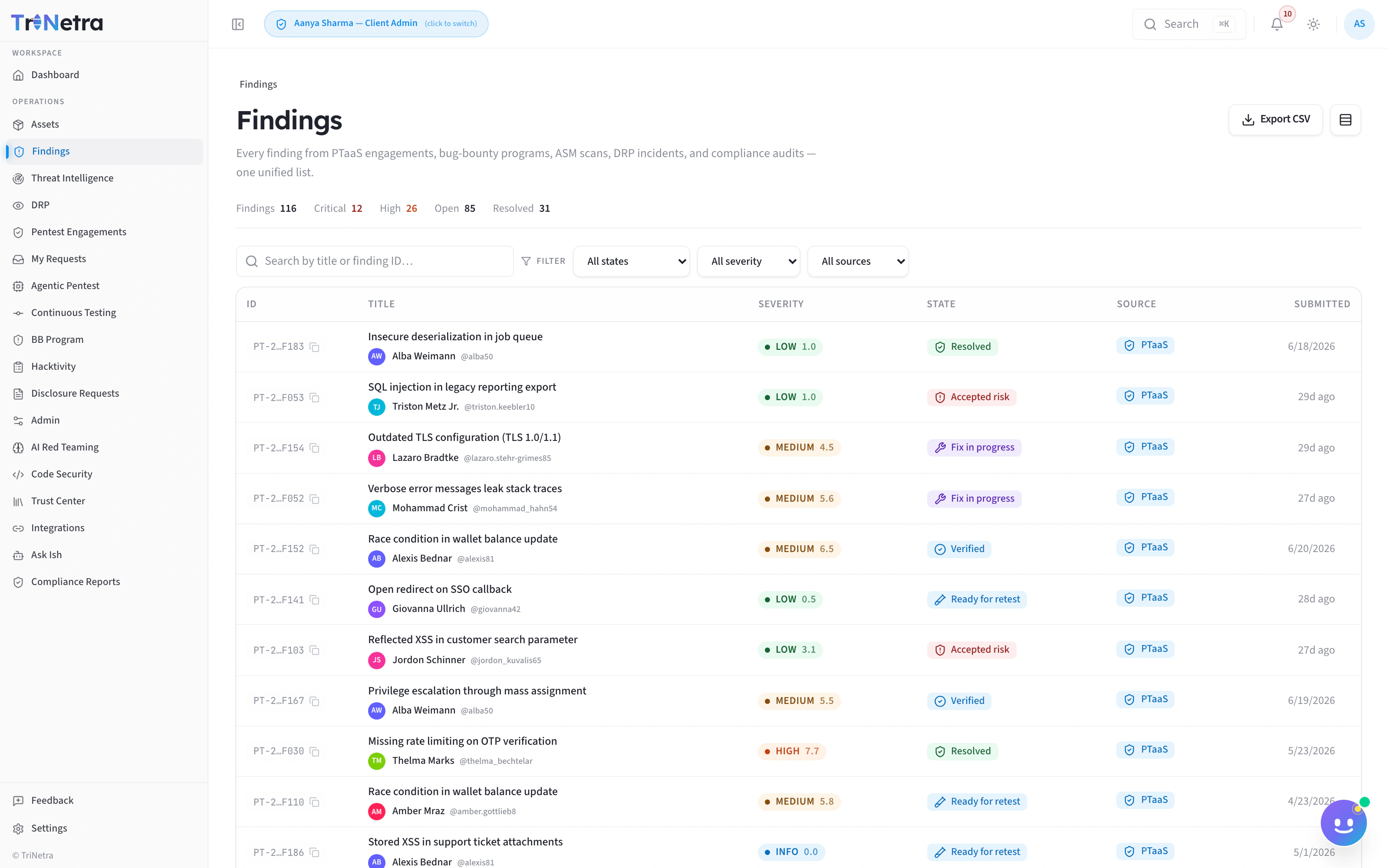
- RBI Cyber Security FrameworkAnnual Assessment 2026PENDING REVIEWReviewView
- ISO/IEC 27001:2022Annual Assessment 2026PENDING REVIEWReviewView
- SOC 2 Type IIAnnual Assessment 2026PENDING REVIEWReviewView
- IRDAI Information & Cyber SecurityAnnual Assessment 2026PENDING REVIEWReviewView
- SEBI Cyber Security & Cyber ResilienceAnnual Assessment 2026PENDING REVIEWReviewView
- ISO/IEC 27001:2022 Cloud AddendumAnnual Assessment 2026PENDING REVIEWReviewView
Why SecurityBoat
The deadline is fixed. The scramble is optional.
Most regulated entities rebuild their CSCRF evidence from scratch each cycle — chasing vendor PDFs, reconciling findings lists, reformatting to the prescribed template. On TriNetra, the report is a generated artifact of testing you already ran. When the cycle comes around, you review, approve, and submit.
See a CSCRF report build itself.
Bring your scope. We'll walk you through a live CSCRF reporting flow — from finding to approved, submission-ready document.
Let's Connect