
TriNetra Platform · Offensive Testing
Pentest-grade signal at the speed of development.
Continuous Testing runs exploit agents against every commit as it ships — not to flag what might be wrong, but to actually attempt the exploit in a live environment and only hand you what worked. The dashboard leads with a Zero-Noise Rate for a reason: it's the whole point.
The problem
Code now ships faster than any quarterly pentest or bounty cycle can cover — which leaves months of unvalidated risk sitting between engagements. Scanners try to fill that gap, but they answer a different question than the one security teams actually need answered. A scanner tells you a pattern looks like SQL injection. It doesn't tell you whether that endpoint is even reachable in production, whether the input actually reaches the query unsanitized, or whether an attacker could get anything useful out of it. So teams get handed thousands of "indicators," triage crawls to a halt, and the handful of findings that are genuinely exploitable sit buried under the ones that aren't.
How Continuous Testing answers it
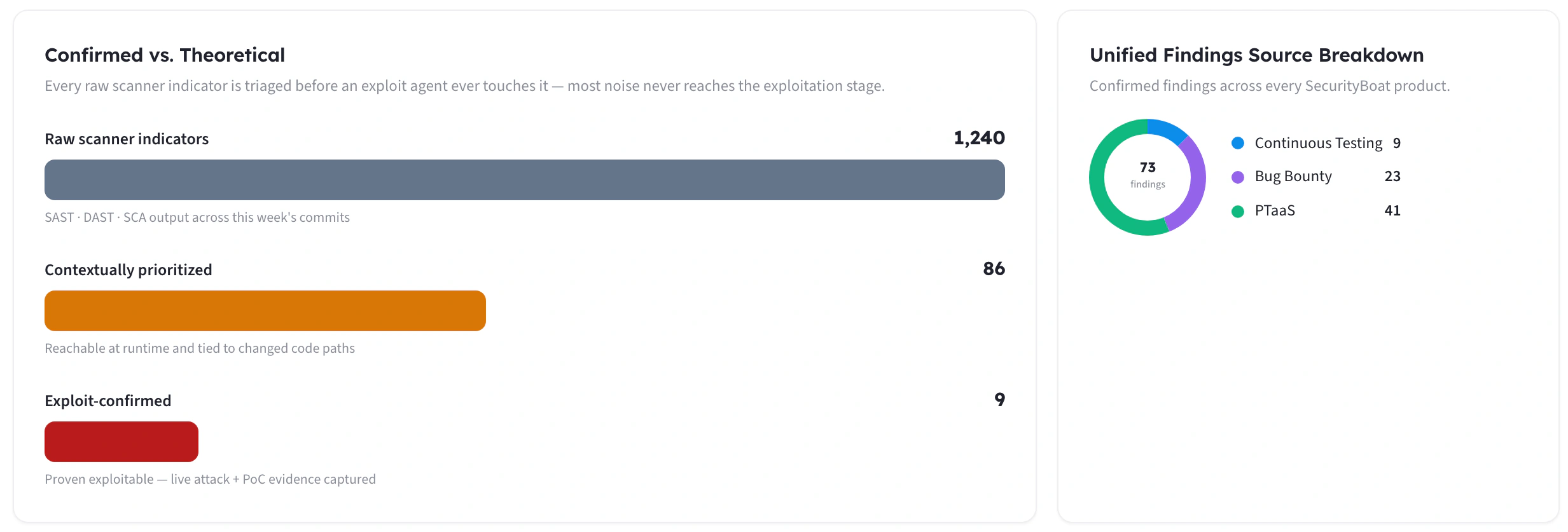
Continuous Testing doesn't stop at flagging. Every finding on the dashboard has already been through a three-stage pipeline, and the module's own KPI strip shows the shrinkage at each stage rather than hiding it — ending in a 98.8% Zero-Noise Rate this week, tracked alongside Confirmed Findings, Commits Scanned, and Exploit Attempts Logged, failures included.
How it actually works
The real funnel, not a marketing claim
SAST, DAST, and SCA tools run across every commit shipped this week and produce their full, unfiltered output — everything theoretically worth a second look.
Indicators are cut down to what's actually reachable at runtime and tied to a code path that changed this week — not a stale finding in code nobody touched.
Dedicated exploit agents attempt each surviving indicator live, in your own environment. Only what's proven exploitable — with a captured attack and PoC evidence — comes out the other end.
Capabilities
What ships in the box
Change-scoped, not calendar-scoped
A funnel that shows its work
Exploit Attempt Log
Proof-of-concept on every confirmed finding
One unified record
Works with
Stronger together
PTaaS
Bug Bounty
Code Security
Ish
FAQ
Common questions
Is the 98.8% Zero-Noise Rate a marketing number?
It's the account's actual dashboard metric this week — the percentage of the 1,240 raw indicators that never made it past prioritization or exploit-confirmation because they weren't real. It moves week to week with what actually shipped.
Does it replace a formal pentest?
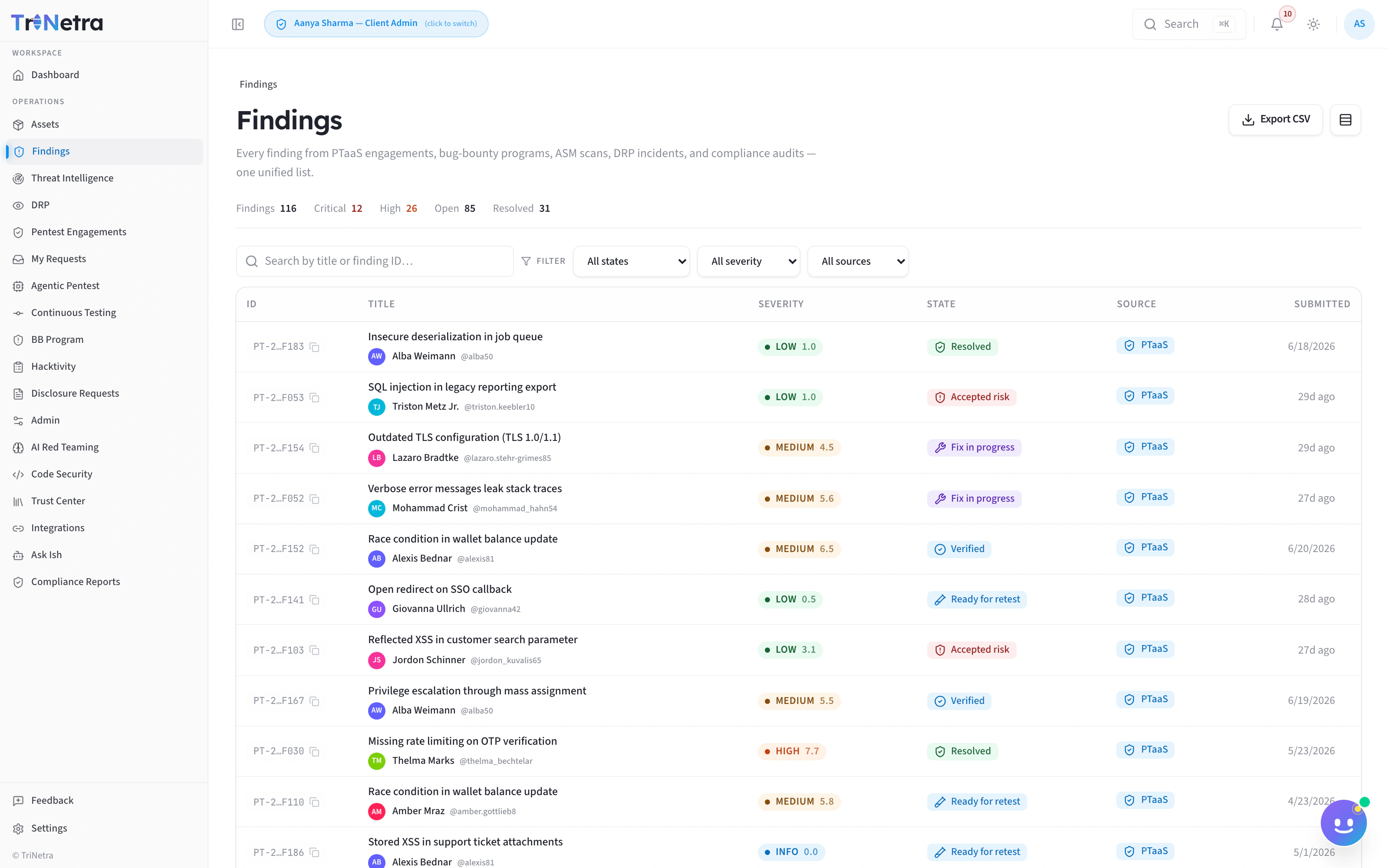
No — it covers the gap between them. PTaaS goes deep on a defined scope on a schedule; Continuous Testing watches what ships in between, feeding the same unified findings record shown in the source-breakdown donut.
What do we get when something is confirmed?
A finding with the exact payload used, step-by-step reproduction, business impact, and CVSS vector — plus code-level fix guidance where source-code integration is enabled.
Close the gap between pentest cycles.
Your code ships weekly. Your proof of security shouldn't ship quarterly. Tell SecurityBoat what you're building and we'll show you what TriNetra's exploit agents confirm on your own scope.
Related: PTaaS · Bug Bounty · Code Security · Ish