
TriNetra · Governance
Audit-ready, from live data.
CCV turns real engagement data into compliance-mapped reports for IRDAI, SEBI CSCRF, RBI, SOC 2, and ISO 27001 — assembled automatically, reviewed by humans, and approval-gated before anyone outside your team sees them. The direction: controls that validate themselves continuously, not once a year.
The problem
Compliance evidence is usually rebuilt from scratch under deadline. Findings sit scattered across engagements, narrative sections get rewritten every cycle, and each regulator wants its own format — a SEBI CSCRF attestation reads nothing like an ISO 27001 report. The work is real; repeating it by hand every audit cycle isn't.
How Continuous Controls Validation answers it
CCV assembles the report from data the platform already holds. Findings, severity counts, scope tables, and testing checklists aggregate automatically across your engagements; your team authors the narrative in a guided wizard with regulatory boilerplate pre-filled; and a region-aware report engine renders the right format for the right regulator — full reports, short-form reports, attestation letters, and CERT-In formats. Nothing reaches a client or auditor until it clears approval. And because reports generate from live engagement data, evidence stops going stale between audits — with continuous automated control testing as the direction the platform is building toward.
How it works
The workflow, end to end
- 01
Aggregate
Findings, severity counts, scope tables, and the VAPT testing checklist pull automatically from every engagement for a client into one report dataset — strictly tenant-scoped, with pre-acceptance findings filtered out before they can ever reach a client-facing document.
- 02
Author
Staff draft the narrative — declaration, executive summary, methodology, exclusions — in a guided wizard with regulatory-default boilerplate pre-filled. Management comments, EPSS scores, and closure dates are captured per finding.
- 03
Generate
The region-aware report engine renders the right output for the right regulator: full reports, short-form reports, attestation letters, and CERT-In formats — as on-screen HTML and generated PDF, with per-section visibility toggles and per-client white-labelled branding.
- 04
Approve
Nothing ships until it clears internal review. Clients and auditors only ever see approved reports — drafts cannot leak through.
- 05
Client loop
Clients raise change requests directly on the report; staff resolve or reopen them, with notifications firing both ways until the record is settled.
- 06
Continuous validation (platform direction)
Where CCV is headed: controls tested automatically on a recurring schedule, results logged and compared over time, drift flagged to a named owner before it becomes next year's audit finding. Not live today — this is the direction the platform is building toward.
Capabilities
What ships in the box
Multi-engagement aggregation
Region-aware report engine
Compliance-mapped frameworks
Guided narrative wizard
Approval-gated delivery
Two-way change-request loop
Tenant-scoped by design
Inside the product
What you actually see
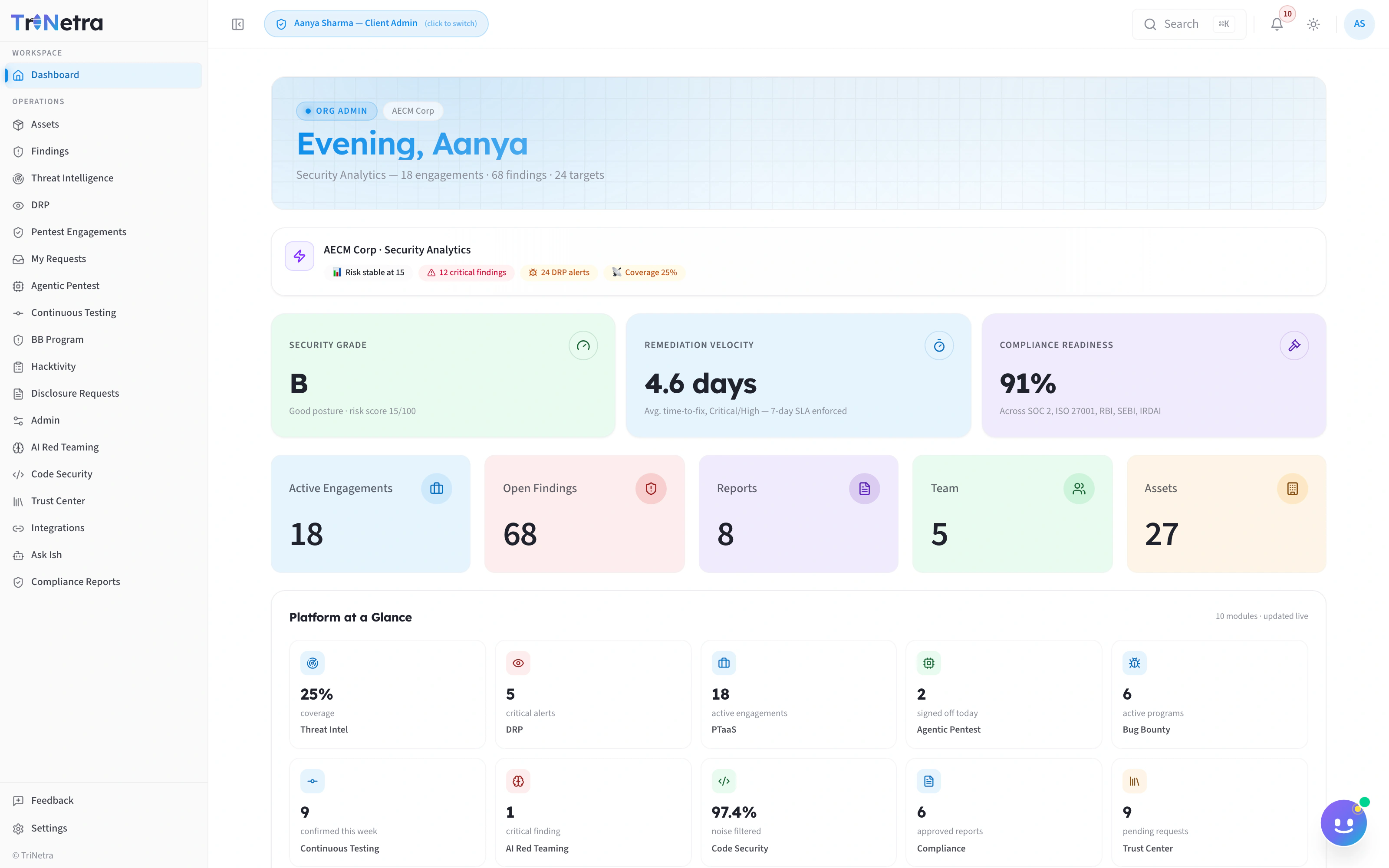
- RBI Cyber Security FrameworkAnnual Assessment 2026PENDING REVIEWReviewView
- ISO/IEC 27001:2022Annual Assessment 2026PENDING REVIEWReviewView
- SOC 2 Type IIAnnual Assessment 2026PENDING REVIEWReviewView
- IRDAI Information & Cyber SecurityAnnual Assessment 2026PENDING REVIEWReviewView
- SEBI Cyber Security & Cyber ResilienceAnnual Assessment 2026PENDING REVIEWReviewView
- ISO/IEC 27001:2022 Cloud AddendumAnnual Assessment 2026PENDING REVIEWReviewView
Works with
Stronger together
PTaaS
Continuous Testing
Trust Center
Ish
FAQ
Common questions
Is continuous automated control testing live today?
Not yet — and we won't pretend otherwise. What's shipping now is compliance-mapped report generation from live engagement data: aggregation, guided authoring, region-aware rendering, approval gating, and the client change-request loop. Continuous automated control testing is the direction the platform is building toward, on the same data foundation.
Which frameworks and formats does CCV support?
IRDAI, SEBI CSCRF, RBI, SOC 2, and ISO 27001 are first-class, with a region-aware engine producing full reports, short-form reports, attestation letters, and CERT-In formats. For the full regulatory landscape we cover, see the Compliance section.
Can a client ever see a draft?
No. Approval gating is built into the delivery model — a report only becomes client-visible after staff approve it, and every subsequent change request is tracked on the record with notifications both ways.
Can reports carry our branding?
Yes. Per-client white-labelled template variants override the standard format automatically, so the report a client receives looks like theirs while the data pipeline behind it stays the same.
Walk into the audit with the report already written.
Tell us which framework is next on your calendar — IRDAI, SEBI CSCRF, RBI, SOC 2, or ISO 27001. We'll show you a report generated end-to-end from live engagement data.
Related: PTaaS · Continuous Testing · Trust Center · Ish