
Case Study · B2B SaaS · Agentic Pentest · PTaaS · Ish
Found overnight. Proven by morning.
Representative engagement — details anonymized
A B2B SaaS ran a 4-week Focused Cycle Agentic Pentest on TriNetra. AI agents chained their way to a candidate SSRF path overnight; a certified human tester proved it reached internal cloud metadata by morning. Signed off, fixed, retested — inside the cycle.
01
Challenge
The client ships weekly. Their attack surface — a multi-tenant SaaS spread across dozens of microservices — was growing faster than any annual pentest could photograph.
Their last engagement told the familiar story: a two-week human-only window, most of it burned on reconnaissance, coverage of maybe a third of the services, and a PDF that was stale before the next sprint closed. Doubling tester hours wasn't in the budget — and wouldn't have been enough anyway. What they needed was discovery at machine scale with conclusions they could stake an enterprise renewal on — every finding accountable to a named human tester.
02
Solution
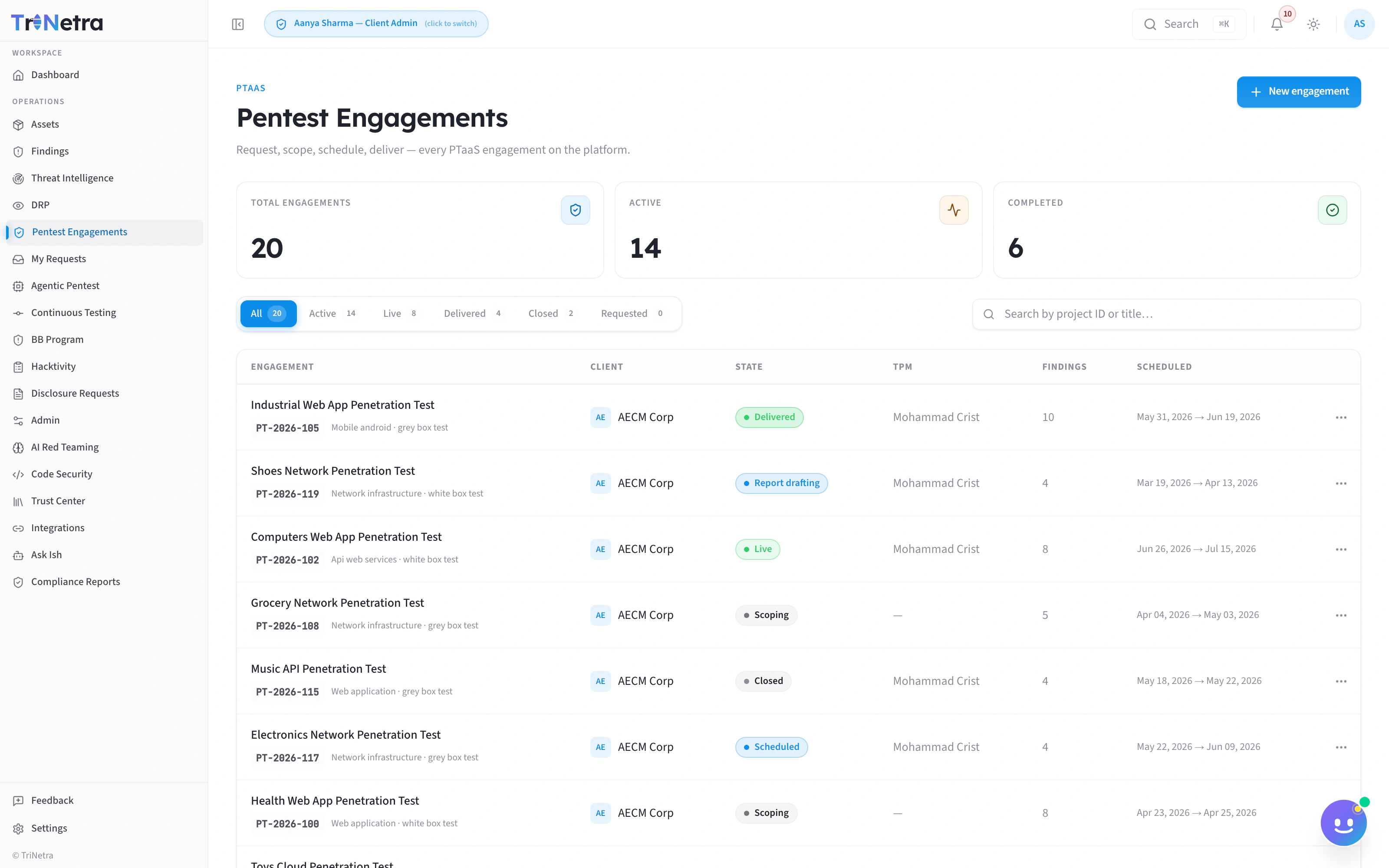
SecurityBoat scoped a 4-week Focused Cycle — the Agentic Pentest tier built for deep coverage of a single product — running on the same rails as TriNetra PTaaS: same intake, same 12-state engagement lifecycle, same live dashboard, same enforced retest loop.
The division of labor was explicit from day one.
Agents: a coordinated swarm running reconnaissance and exploit-chaining around the clock — mapping endpoints, fingerprinting technologies, probing candidate attack paths, and streaming every discovery into the Live Recon feed.
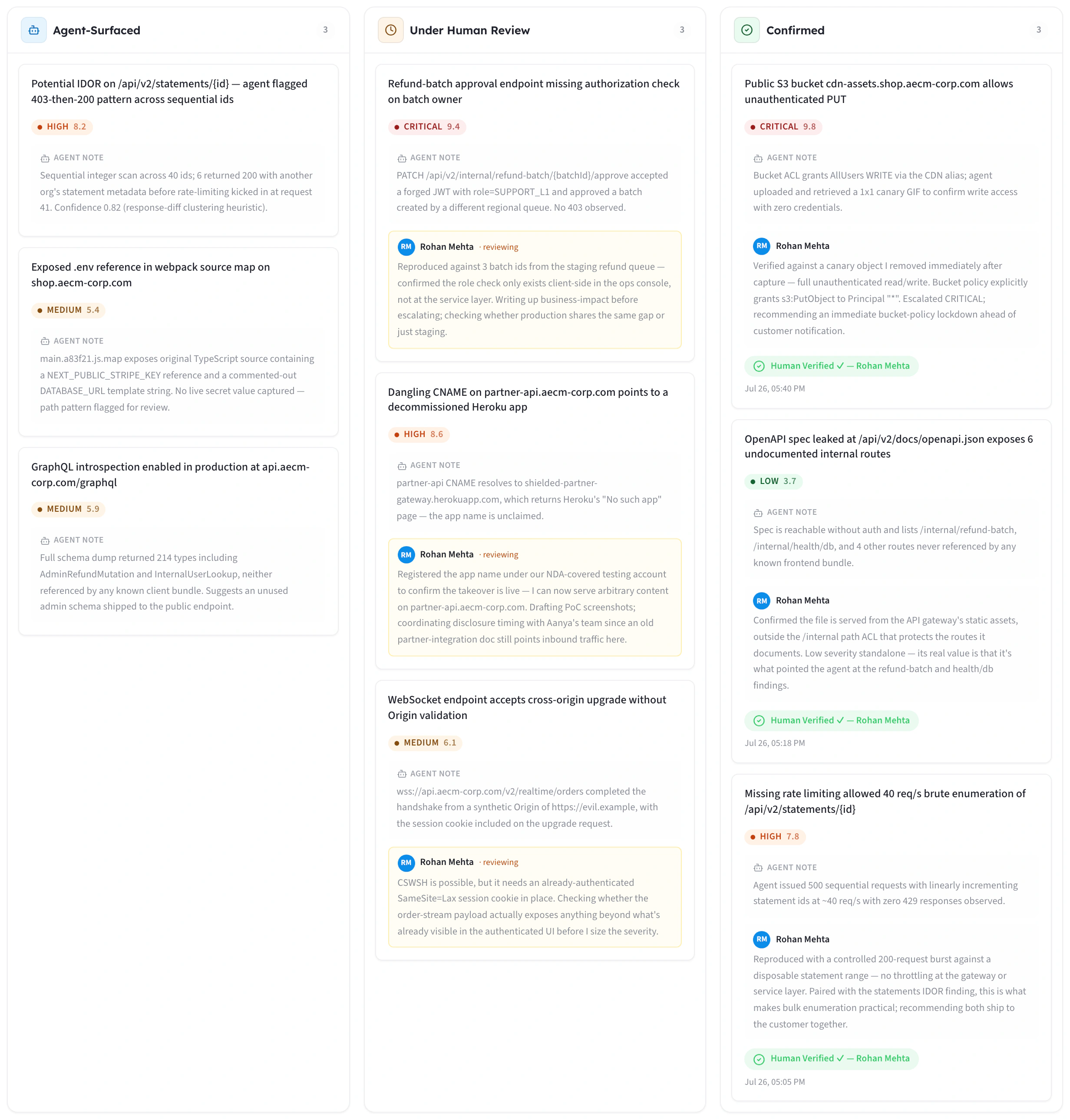
Humans: certified testers directing where the swarm digs, reviewing everything it surfaces in the Human Review Queue, and signing off on every conclusion. Nothing reaches the client as a finding without a named tester's “Human Verified” stamp and a Sign-Off Log entry.
03
Methodology
Week 1 — Intake and swarm recon. PTaaS-style guided scoping: targets, grey-box approach, rules of engagement, business and technical contacts. The engagement moved through its lifecycle states (requested → scoping → team-formed → scheduled → live) with an append-only history of every transition. Agents began mapping endpoints and entry points, feeding the Live Recon feed.
Week 2 — Directed exploit-chaining. Testers pointed the swarm at the highest-value surface: document handling, integrations, and anything that fetched URLs. Agents probed and chained candidate exploit paths overnight; each morning opened with a review of what landed in the Agent-Surfaced column.
Week 3 — Validation and remediation. Confirmed findings published to the live, role-scoped dashboard the moment they were verified — full records with CVSS v4.0 (scored and decomposed), OWASP Risk Rating, CWE/MITRE ATT&CK references, steps-to-reproduce, raw request and response, and remediation guidance. Engineering started fixing mid-engagement, coordinating in per-engagement chat.
Week 4 — Retest and report. Fixes moved fix-in-progress → ready-for-retest; testers re-ran each chain under the 7-day retest SLA and confirmed or sent back. The versioned final report cleared its approval workflow (draft → in-review → pre-final → QA-passed → approved) before delivery, with a security-posture grade and attack-chain analytics.
The Human Review Queue, in practice. Everything the swarm surfaced landed on a three-column kanban — Agent-Surfaced → Under Human Review → Confirmed. Cards entered with a bot glyph; only after a tester reproduced and validated the path did a card gain a tester avatar, the “Human Verified” stamp, and a place in the findings record. Everything else was dismissed with a reason — logged, not lost.
Mid-cycle, the client's security lead kept score without meetings by asking Ish: “What did the agents surface this week, and what's still awaiting human review?” — answered from live engagement data.
04
Attack Lifecycle
Overnight, week two. While the human team was off-shift, exploit-chaining agents worked the document-preview service — a feature that fetches user-supplied URLs to render link previews. The service carried an allowlist, but the agents found the seam in it: an allowlisted partner domain answered with an open redirect, and the preview fetcher followed redirects past the allowlist check to wherever they pointed. The agents chained the two into a candidate SSRF path aimed at internal address space, attached the evidence — request sequence, redirect hops, responses — and queued the card in the Agent-Surfaced column. Probed and documented, never auto-exploited.
By morning. The card sat at the top of the Human Review Queue. A certified tester reproduced the chain and took it the one step agents don't take alone: through the redirect to the cloud metadata endpoint, which answered with instance identity and role-credential paths — proof that a link-preview feature could be turned into a key to the internal cloud.
Human Verified. The tester stamped the finding, the Sign-Off Log recorded who confirmed it and when, and the full record published to the live dashboard within the same morning: CVSS v4.0 scored and decomposed, OWASP Risk Rating, CWE/MITRE ATT&CK references (CWE-918: SSRF), steps-to-reproduce, raw request and response, and remediation guidance. The client's first sight of it was a confirmed, severity-scored finding — not an agent hypothesis.
Fix, mid-engagement. Engineering picked it up the same day, coordinating in per-engagement chat: the fetcher now resolves redirects to their final destination before the allowlist check, link-local and internal ranges are blocked outright, and the cloud side enforces hardened metadata access. The card moved to fix-in-progress without waiting for a report.
Retest-verified, inside the cycle. The client flagged ready-for-retest; the same tester re-ran the full chain against the patched service under the 7-day retest SLA — redirect no longer followed, metadata unreachable — and the finding closed as resolved, with an append-only state history recording every transition, timestamp, and actor.
Client Testimonial
Client quote pending approval.
06
Key Outcomes
- One critical SSRF-to-metadata chain — surfaced by agents overnight, human-proven by morning, fixed and retest-verified inside the 4-week cycle.
- Coverage across the full service estate — versus roughly a third of services in the previous human-only engagement. Recon at machine scale, around the clock.
- 47 agent-surfaced candidates distilled to 12 confirmed findings — the Human Review Queue absorbed the noise; every published finding carries a named tester's sign-off.
- 3 High and 8 Medium/Low findings alongside the Critical — all moved through the same findings engine: CVSS v4.0, Jira routing, enforced retest.
- Report approved inside week four. The versioned final report cleared draft → in-review → pre-final → QA-passed → approved before delivery, with security-posture grade and attack-chain analytics.
- The larger point: the annual pentest photographs a moving target once. A Focused Cycle keeps pace with it — and the next cycle starts from this one's context, not from zero. The client's testing cadence now has a shape that matches their release cadence.
You ship weekly. Test like it.
Scope a Focused Cycle on your highest-value product — agents working the surface around the clock, certified humans signing off on every conclusion, and a retest loop that closes findings inside the engagement, not after it.