
Solutions / Use Cases
Your release cadence outran your test cadence
Web apps, APIs, and mobile clients ship weekly. The pentest that's supposed to cover them still happens once or twice a year, against whatever the app looked like the week it was scoped. Everything shipped in between — new endpoints, a refactored auth flow, an AI-assisted PR nobody reviewed line-by-line — goes untested until the next scheduled engagement finds it, or an attacker does first.
Where this actually breaks
Auth and session logic changes between pentest cycles, quietly reopening bugs a previous engagement already closed.
Legacy SAST/SCA tooling flags every theoretically-possible issue on every PR, drowning real findings in noise nobody has time to triage.
A single static PDF at the end of a pentest means remediation can't start until testing is fully over.
Mobile (iOS/Android) and API layers get less coverage than the web front end because they're scoped separately, if at all.
How TriNetra covers it
PTaaS
PTaaS runs scoped, recurring engagements — not a single annual test — across web, API, mobile, and source code, with testing approach set explicitly to black, grey, or white box. Findings publish to the dashboard the moment a tester verifies them, through the real 12-state lifecycle (Requested → Draft → Scoping → Open to assign → Team formed → Scheduled → Live → Report drafting → Report review → Delivered → Remediation → Closed), tracked across Brief / Assets / Team / Coverage / Findings / Analytics / Reports / Chat / Integrations. Coverage is measured against a named methodology like OWASP WSTG — Tested / In progress / Not started / N/A counts, not a vague “we tested it.”
Continuous Testing
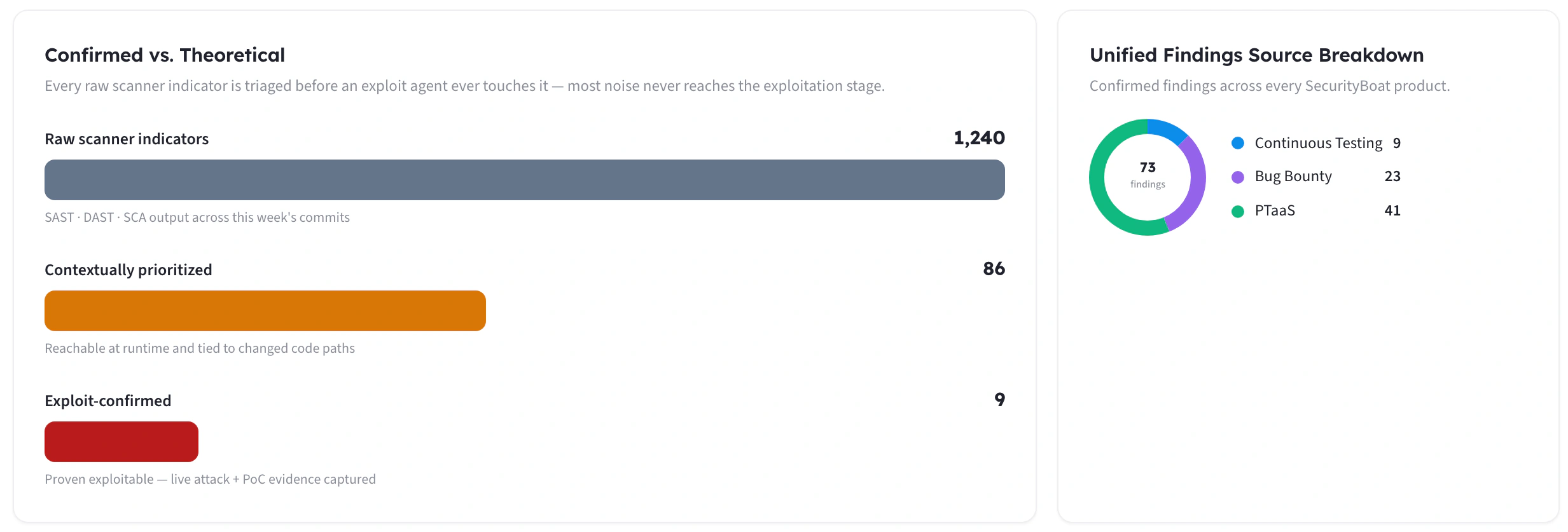
Continuous Testing fills the gap between cycles. Recon agents map every new endpoint as code ships, scanning agents rank by exploitability instead of static severity, and exploit agents confirm each one directly in your environment — only PoC-backed findings reach a human. The real reported split: 1,240 raw indicators narrowed to 86 contextually-prioritized, narrowed again to 9 exploit-confirmed — a 98.8% zero-noise rate.
Code Security
Code Security works a layer earlier, at commit and PR time — Semgrep/CodeQL plus SCA output reasoned against actual data flow before a human ever sees it: 1,204 raw findings in a typical week, 31 passing triage, 6 escalated.
The workflow
- 1
Request a PTaaS engagement — pick the asset (web, API, or mobile), engagement type, and scope description; SB1 reviews and confirms scope within a business day.
- 2
Testing goes Live — findings publish to the dashboard in real time, discussed in the engagement Chat, tracked against Coverage.
- 3
Between formal cycles, Continuous Testing and Code Security keep validating every new deploy and PR against the same findings model.
- 4
Everything — PTaaS, Continuous Testing, and Bug Bounty findings — lands in one governed record, not three separate tools.