Solutions / Use Cases
Every tool tells you something. Nothing tells you everything.
An external scanner reports what it found. A pentest reports what testers found, scoped to what they were asked to look at. A bug bounty program reports what researchers found, whenever they happened to look. Individually, each is accurate. Together, without a shared record, they're three disconnected lists that nobody has reconciled — which means nobody actually knows the org's real, current exposure at any given moment, only a set of partial snapshots taken at different times by different people.
Where this actually breaks
The same weakness can be flagged separately by a scanner, a pentester, and a bounty researcher — three tickets, three timelines, no way to tell it's one issue.
Point-in-time assessments (annual pentest, quarterly scan) leave the gaps between them unmonitored — exactly where drift accumulates.
Exposure outside your own infrastructure — phishing clones, leaked credentials, impersonation — isn't visible to any tool that only watches assets you own.
Prioritization becomes a manual, cross-tool exercise, because severity scoring isn't consistent between a scanner's CVSS guess and a pentester's validated exploit.
How TriNetra covers it
Attack Surface Management
ASM is the continuous inside-out and outside-in layer: every scan is diffed against the last, so drift is flagged the moment it appears (new, regressed, and resolved exposures, each explicitly badged), and coverage tracks as a live percentage against defined scope with freshness-breached assets called out by days overdue. “We're covered” becomes a measured, re-verified number, not an assumption.
Digital Risk Protection
DRP runs the same continuous model against everything outside your owned infrastructure — phishing clones, leaked credentials, dark-web mentions — correlated against ASM's asset inventory so a leaked credential and the exposed endpoint it belongs to get connected, not filed as two unrelated alerts.
Continuous Testing + Bug Bounty + PTaaS
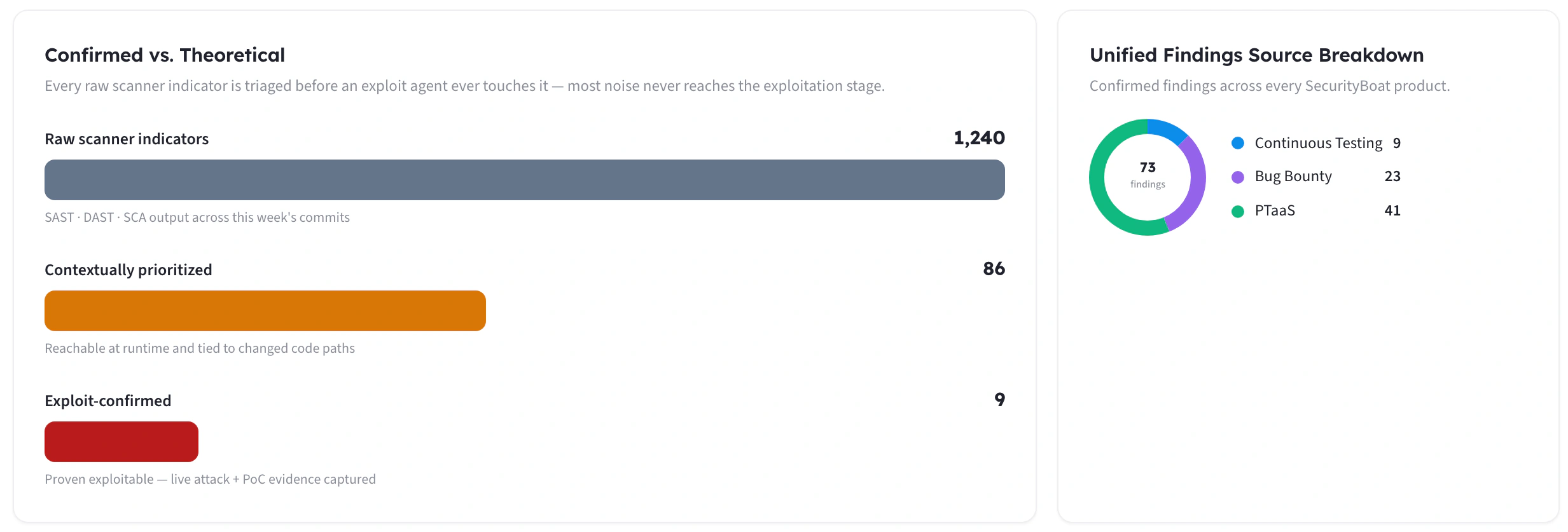
Continuous Testing, Bug Bounty, and PTaaS all write to the same governed findings record rather than three separate systems — the real, current split: Continuous Testing 9 confirmed findings, Bug Bounty 23, PTaaS 41, for 73 total tracked in one place. One severity model, one state machine, one place to ask what's actually open.
Ish
Ish is the single interface across all of it — ask “is anything impersonating our brand right now” or “what are my highest-priority findings right now” and get an answer sourced from the live records across every module, instead of opening four dashboards. Ish reads and reports; it never takes action on your behalf.
The workflow
- 1
ASM and DRP run continuously, each diffed against its own prior state to surface drift the moment it happens.
- 2
PTaaS, Bug Bounty, and Continuous Testing findings all land in one governed record with one severity model.
- 3
Ask Ish for a cross-module answer instead of reconciling dashboards by hand.
- 4
Every finding tracks through the same state machine to Resolved — one record, one owner, one truth.