
Solutions / Use Cases
The network diagram is a snapshot. Your infrastructure isn't.
Ask most security teams for a current map of every domain, IP range, and ASN their organization is responsible for, and the honest answer is a spreadsheet that's months out of date. Subsidiaries provision infrastructure without telling central IT. A subnet from an acquisition never gets formally inventoried. A test environment goes up for a sprint and never comes down. None of that shows up until it's already exposed.
Where this actually breaks
Internal/external network segments and legacy protocols rarely get the same test rigor as customer-facing web apps — harder to scope, easier to defer.
An ASN's announced netblocks include infrastructure nobody remembers owning — exactly the infrastructure with the weakest controls.
Point-in-time scans miss what changes between them; a port closed at scan time can be open a week later with nobody watching.
Network pentest findings and external attack-surface findings usually live in two different tools, so nobody sees the full picture.
How TriNetra covers it
Attack Surface Management
ASM's Add Target flow is the actual onboarding mechanic: pick a target type — Domain, IP, or ASN — enter the value, set a monitoring schedule and a freshness SLA override, and optionally leave a note for the reviewer. The product copy is exact: “Submit a target for review — our security team approves and runs the scan.” An ASN auto-expands to its announced netblocks, pulling in infrastructure you forgot you were responsible for. From there, ASM's live subdomain inventory tracks every asset with a classification tag (web / api / admin / dev / infra / cloud), live/down status, last HTTP response, and a per-asset monitoring toggle — an inventory that updates itself instead of aging into a spreadsheet.
PTaaS
PTaaS scopes internal and external network engagements like any other asset class — black, grey, or white box, tracked through the same 12-state lifecycle, with a Coverage tab measuring methodology completion against a named framework instead of “we looked at it.”
Agentic Pentest
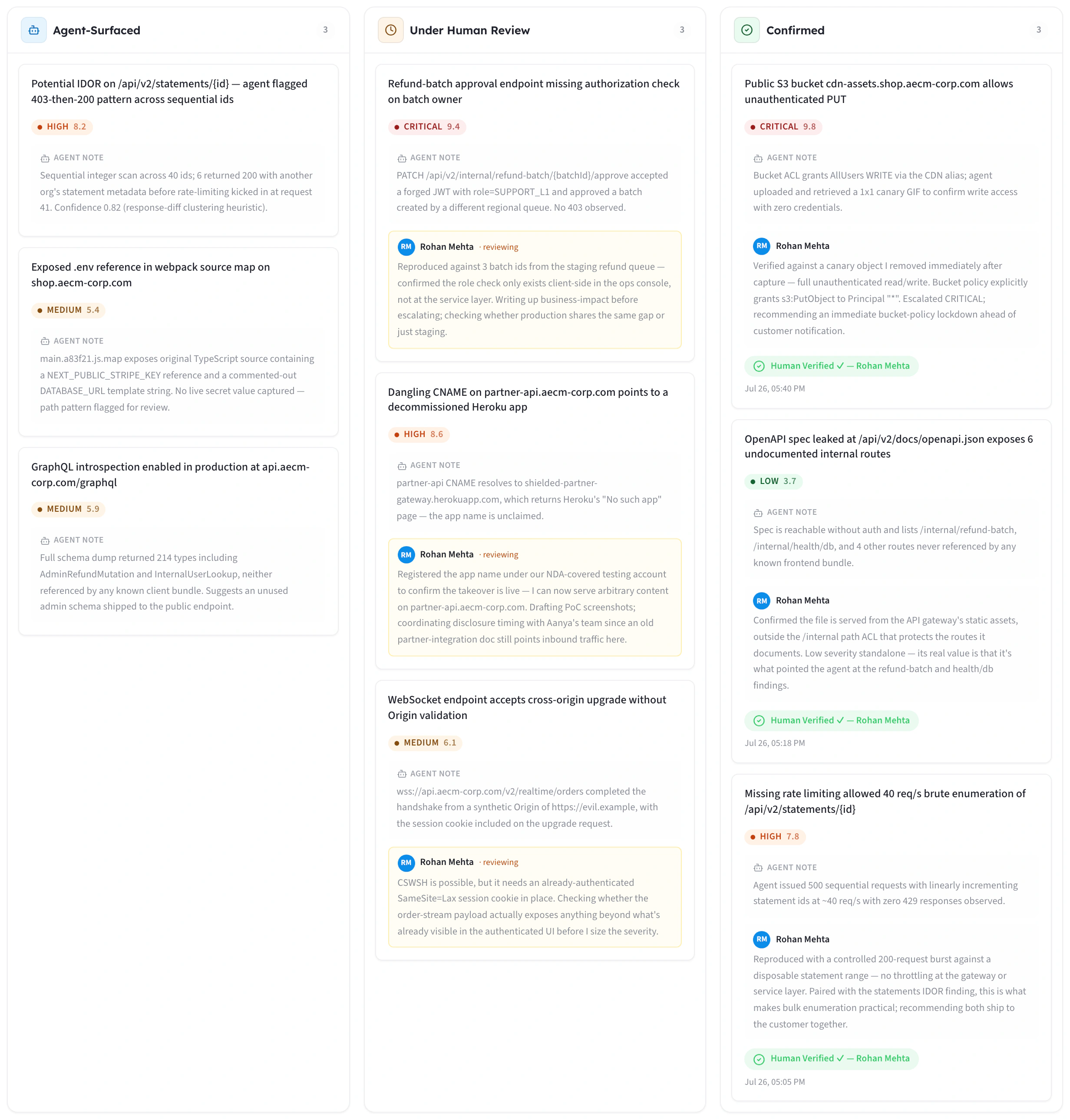
Agentic Pentest matters most here because network attack surfaces expand faster than tester-hours scale — a coordinated agent crew handles reconnaissance at a pace no human team matches alone, surfaced into the real Human Review Queue kanban (Agent-Surfaced → Under Human Review → Confirmed) so every conclusion that reaches you has passed a human.
The workflow
- 1
Submit a Domain, IP, or ASN target through Add Target — set the monitoring schedule and freshness SLA.
- 2
The security team approves scope; the scan runs and populates the subdomain and asset inventory.
- 3
A PTaaS engagement scopes deeper manual testing against what ASM found reachable.
- 4
Agentic Pentest keeps recon current on newly discovered segments between formal cycles.